



 4:56 AM
 JAJANG DURAHMAN


Showing posts with label Jabon. Show all posts
Showing posts with label Jabon. Show all posts
Monday, August 16, 2010
LOCATION PLANTING

ASPECT OF LANDS AND LICENSING

From the side of land licensing is land owned by farmers built a legitimate and already has approval from the central and local government for planting timber trees type (Anthochephlus Cadamba). This will facilitate us in the transaction and settlement administration in all sectors.
STEWARDS

PT KSATRIA PETA INDORAYA an management team that is moving as agribusiness flourish, from the long side of history is not yet formed. But with the experience and capabilities of our team have long experience as a flourish, particularly the expansion of agribusiness. Until the ability of both sides and quality of human resources supporting capacity without a doubt. Experience in developing agribusiness is optimism that has carried us to be able to resolve the agribusiness partnership program anthocephalus cadamba wood forest products with good qualities, can satisfy the various parties and will hopefully be resolved right time.
Sunday, August 15, 2010
TAXONOMY AND NOMENCLATURE

TAXONOMY AND NOMENCLATURE
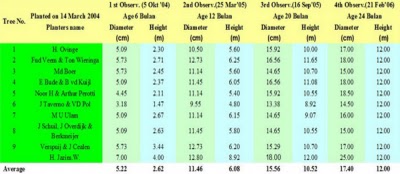
Family: Rubiaceae, Synonyms: Anthocephalus cadamba Auct., A.cadamba (Roxb.) Miq., A. A. indicus Rich., A.morindaefolius Korth. , Local Name: Kadam (India, France and trade names); Kelampayan, Kawak, Jabon (Indonesia). Distribution and Habitat ,natural distribution in the start of India, Nepal and India, to Thailand and Indochina and eastern Malayan Islands to Papua New Guinea. This plant has been introduced in Africa and Central America and able to adapt well. ,In Indonesia, these plants are on the island of Java, Sumatra, Kalimantan, Sumbawa and Irian Jaya. , It is a typical pioneer plants and common in secondary forest. The kind that requires light and is not tolerant of cold weather. In its natural distribution, these plants grow well at altitude of 0000-1000 m above sea level with an average rainfall of more than 1500 mm / year, on clay, Podsolic chocolate, and there is generally a moist alluvium along the river that beraerasi good. , However Anthocephalus cadamba can also grow in dry areas with rainfall at least 200 mm / year and also tolerant of periodic inundation of water conditions. , Always green. In the wild the tree can reach 45 m high with a diameter of more than 100 cm, while the free boundary of its branches reaching up to 25 m. At the age of 3 years can reach 17 m high with a diameter of 30 cm. Canopy shape like an umbrella with a branching system that is not circular with thick leaves with a length of 13-32 cm. Orange flowers are small, valvate meetings, round. Trunk straight cylindrical and does not buttress. The wood is creamy white to reddish brown.
TREE Anthocephalus cadamba, relatively unheard of farmers engaged in cultivation of cash crops in the region. In fact, the tree named latin antochepalus cadamba have high economic value. Anthocephalus cadamba tree logs, among others, could be utilized as raw material for plywood, vinir, parking wood, plywood, furniture. In fact, it is said the quality of timber produced better than falcataria tree. At least, Anthocephalus cadamba could be an alternative for farmers to replace crops that sengon tumor rust disease. To introduce the tree of Anthocephalus cadamba, PT KSATRIA PETA INDORAYA cooperate with the first residents have conducted tree planting Anthocephalus cadamba in several District in Ciamis, Cilacap other districts also. The plan, broad-leaved tree will be planted only in the area of 50 hectares spread over Ciherang Village, padaherang, and Banjarsari. Planting location is land owned by citizens, but on the basis of the demand for crops such Anthocephalus cadamba we were being planted around 120 hectares of land ranging from 100 000 trees in the built farming communities. Planting Anthocephalus cadamba a forest development program in partnership with instansinya. Menaman society on their own land, while PT. KSATRIA PETA INDORAYA help seed and fertilizer. Anthocephalus cadamba plants chosen because it is fast growing (in about five years, can be harvested with trunk diameters over 30 cm and has a height of up to 18 meters). Plants have a cylindrical rod, with a relatively good level of alignment and no need to prune tree branches, leaves shed because of the character itself. Plants have a cream-colored wood, smooth texture, and easy to peel. Quality''trees tend to do better, than other tree. Within five years, farmers are expected to reap the benefits of hundreds of millions. We are optimistic, Anthocephalus cadamba plant has good prospects ahead. Moreover, Indonesia's wood needs currently about 18 million m3 per year, while timber production is available each year ranges from 9 million m3. Conditions in the field, some communities in the region Ciamis, Cilacap, Wonosobo and its surroundings, which during the planting paraserianthes, seems to be a worry to continue cultivating these plants. This was after, many of which attacked plants tumors sengon rust. Young trees and adult disease''meat''in the branches grow paraserianthes it, almost certainly will dry up and die. Meanwhile, so far there is no cure for the disease of plants. Anthocephalus cadamba''easy to grow in areas with a maximum altitude of 1300 meters above sea level, and does not require special treatment, tumors resistant to rust disease.
GROWTH OF ANTHOCHEPHALUS CADAMBA

STEM anthochephalus cadamba stem traits and characteristics were: wood surface smooth and perpendicular direction, similar to creamy yellow meranti, stems easily peeled, dried, glued, timber free from eye defects
PLANTING and MAINTENANCE
anthochephalus cadamba is an easy crop to grow and develop does not require much special treatment in aquaculture



Aptesi Daerah


